UI / UX Design
Car Rental App
Designing a car rental experience that adapts to different user needs, supporting renters, vehicle owners, and administrators at every step of their journey.
Year :
2024
Role :
Project Manager & UI/UX Designer
Client :
GyroGoGo
Project Duration :
20 weeks
CONTEXT
From Research to Launch: Building GyroGoGo
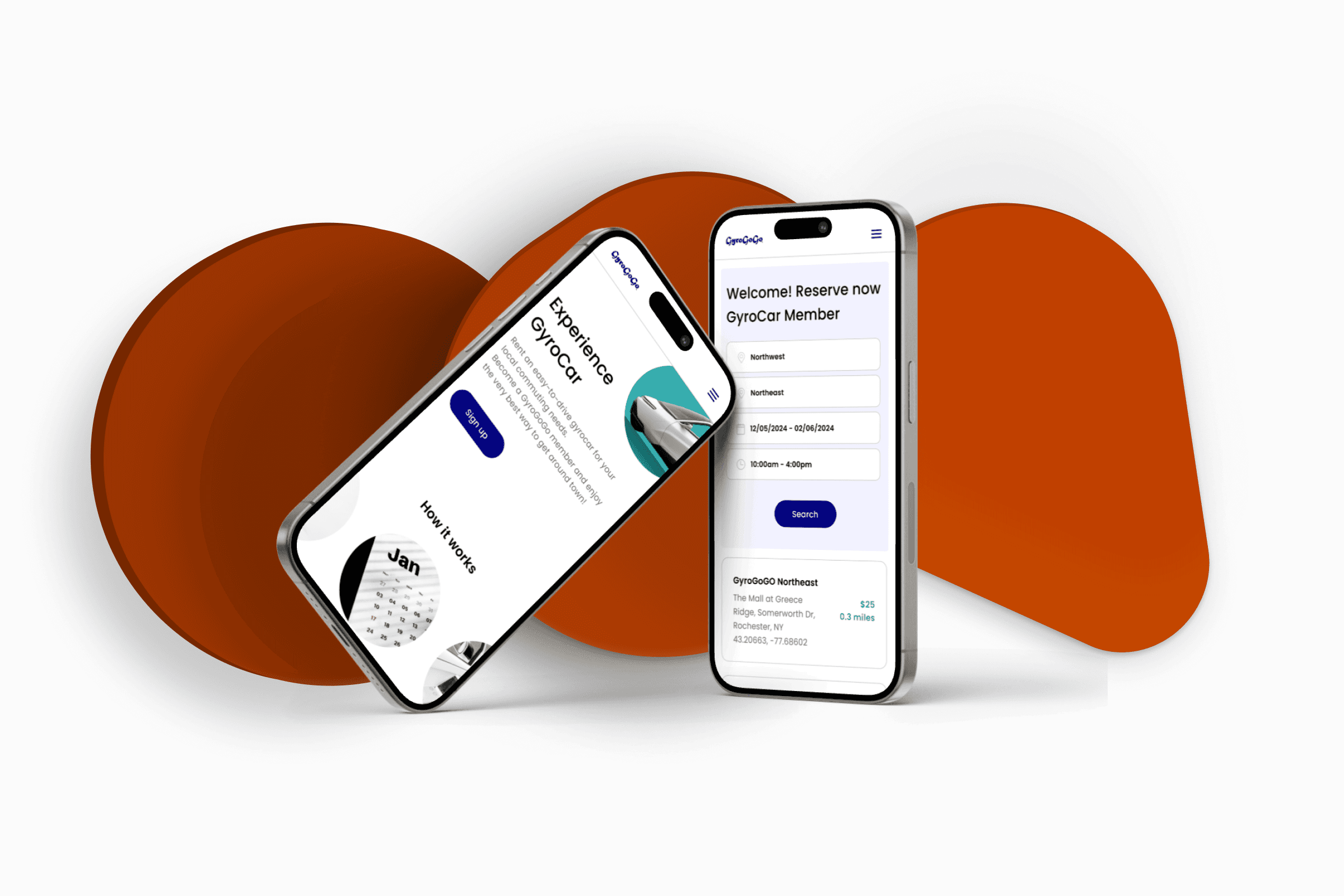
GyroGoGo is a Rochester-based startup building a local car rental web app. Over two quarters, we designed a user-centered platform that won first place among over 40 agencies for its usability and supported customers and internal teams within one scalable system.
PERSONAS
Different User Groups. Different Needs And Wants.
We needed one platform that was able to provide the needs and wants for multiple user groups.
Existing Customer
Emanuel is a frequent renter who needs a secure and easy-to-navigate car rental experience because it allows them to quickly register, book, manage reservations, and receive timely notifications without confusion.
Potential Customer
Taylor is a first-time visitor who needs an approachable homepage experience because it helps them understand the service, benefits, and with trust begin the registration process.
Employee
Chris is a verification specialist who needs an organized dashboard with approval tools and customer records because it enables them to efficiently validate driver information, activate accounts, and manage accounts accurately.
Mechanic
Riley is a fleet mechanic who needs centralized, real-time vehicle data because it helps them monitor battery levels, maintenance history, and reported issues to keep the fleet operational and safe.
Admin
Morgan is a system administrator who needs secure permissions and content management access because it allows them to oversee operations, manage employee access, and maintain the platform.
GROWING PAINS
Managing Ambiguity
The Reality
We initially assumed managers operated independently from employees. In reality, managers carried dual responsibilities: administrative oversight (employee account creation and review) while also engaging in customer-facing workflows similar to those of employees. This required the web application to support both administrative and operational responsibilities within a single role.
What we did
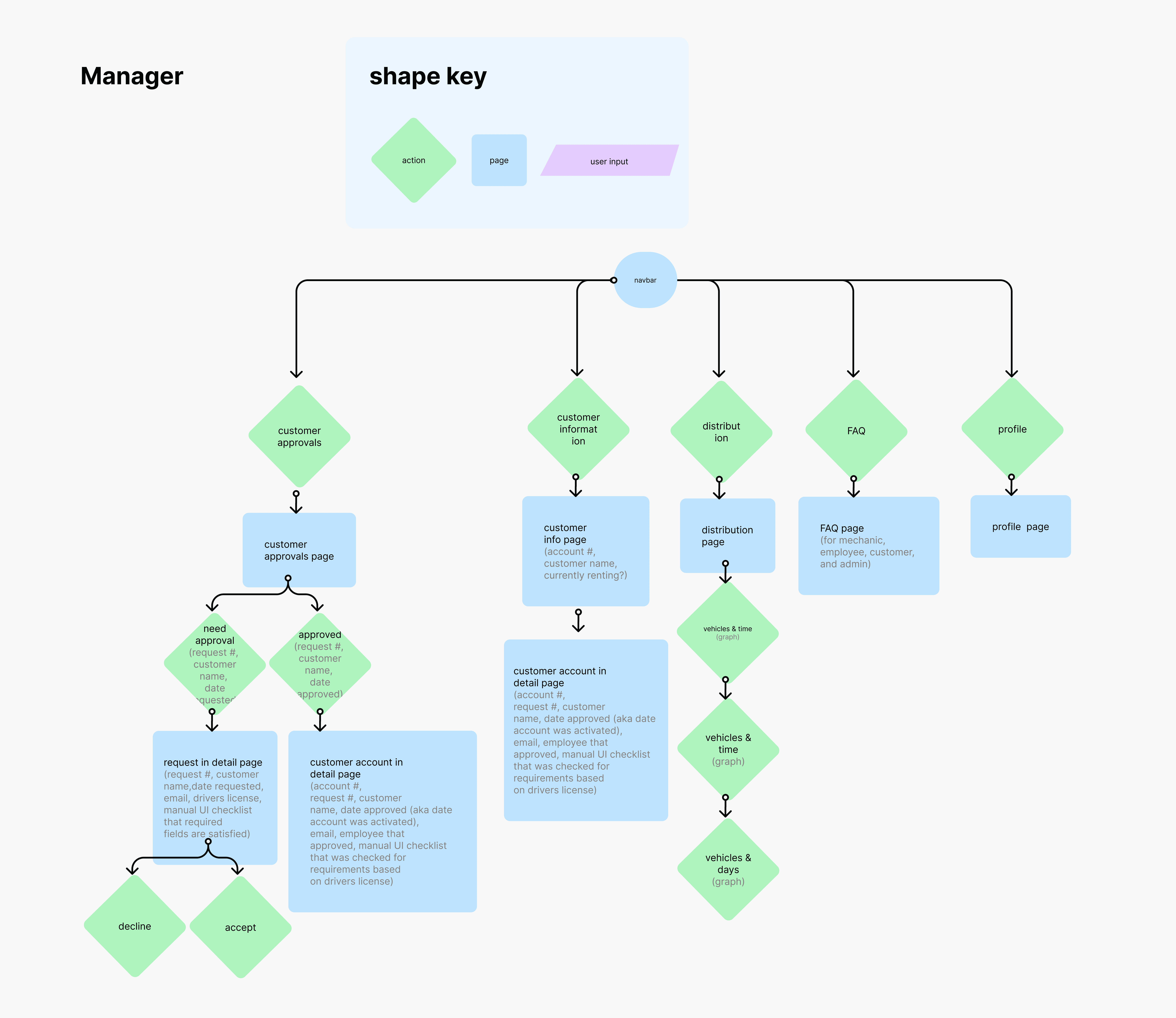
We mapped the manager workflow to remove ambiguity and to clarify overlap between roles. We validated role responsibilities with stakeholders to remove any assumptions.
The Breakthrough
The refined user map eliminated ambiguity around role boundaries rather than assumptions, creating stakeholder alignment and providing a clear foundation for low-fidelity design.
Design Impact
Because roles overlapped, we introduced role-based dashboards to keep things consistent while tailoring each view.


Communicating Effectively
The Challenge
Our initial Waterfall approach made it difficult to adapt as requirements evolved, leading to unclear ownership and misalignment between design and development.
The Shift
We transitioned to Agile Scrum, using Jira to structure sprints and clarify task ownership. This improved transparency and collaboration across teams.
As a result, turnaround time for tasks across departments (design, front-end, and back-end) decreased from 2–3 weeks to roughly one week per sprint, increasing iteration speed and reducing rework.

Refining The Homepage For Better User Experience
Insights from user behavior and client feedback revealed a critical gap in how the homepage supported conversion.
The Problem
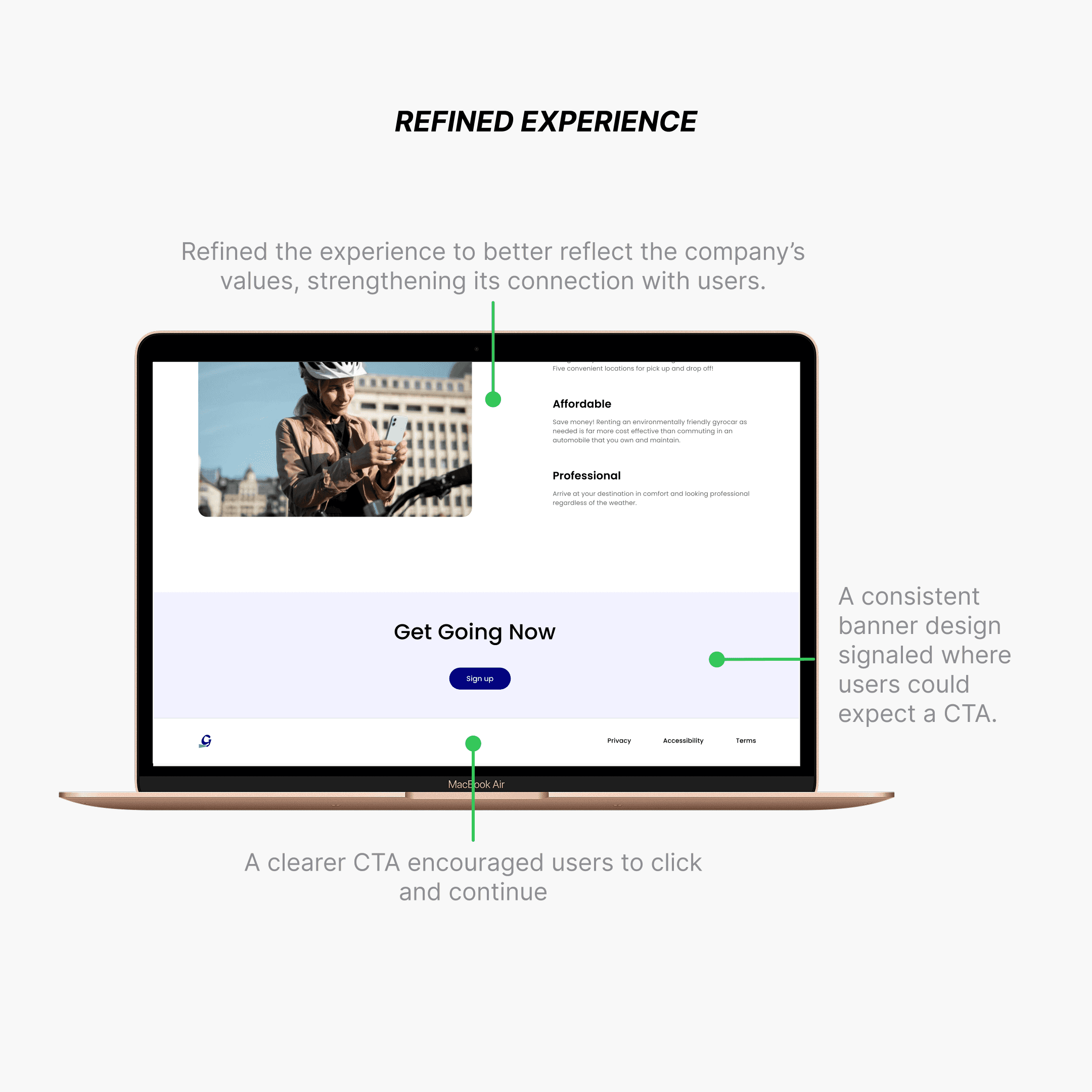
When we presented the LO-FI, tere was no way to build loyalty and promote sign-ups on the website.
Design Approach
Shifted the homepage to be more action-driven by removing the testimonial section, which strengthened the visual hierarchy and making the sign-up call to action more noticeable.
Insights from user behavior and client feedback revealed a critical gap in how the homepage supported conversion.
Outcome
A more focused experience that made it easier for users to understand the value of GyroGoGo and for the company to build loyalty. Stakeholder had positive feedback since their business objectives was to focus on the marketing aspect of the site.
GROWING PAINS
Managing Ambiguity
The Reality
We initially assumed managers operated independently from employees. In reality, managers carried dual responsibilities: administrative oversight (employee account creation and review) while also engaging in customer-facing workflows similar to those of employees. This required the web application to support both administrative and operational responsibilities within a single role.
What we did
We mapped the manager workflow to remove ambiguity and to clarify overlap between roles. We validated role responsibilities with stakeholders to remove any assumptions.
The Breakthrough
The refined user map eliminated ambiguity around role boundaries rather than assumptions, creating stakeholder alignment and providing a clear foundation for low-fidelity design.
Design Impact
Because roles overlapped, we introduced role-based dashboards to keep things consistent while tailoring each view.
Communicating Effectively
The Challenge
Our initial Waterfall approach made it difficult to adapt as requirements evolved, leading to unclear ownership and misalignment between design and development.
The Shift
We transitioned to Agile Scrum, using Jira to structure sprints and clarify task ownership. This improved transparency and collaboration across teams.
As a result, turnaround time for tasks across departments (design, front-end, and back-end) decreased from 2–3 weeks to roughly one week per sprint, increasing iteration speed and reducing rework.
Refining The Homepage For Better User Experience
Insights from user behavior and client feedback revealed a critical gap in how the homepage supported conversion.
The Problem
When we presented the LO-FI, tere was no way to build loyalty and promote sign-ups on the website.
Design Approach
Shifted the homepage to be more action-driven by removing the testimonial section, which strengthened the visual hierarchy and making the sign-up call to action more noticeable.
Insights from user behavior and client feedback revealed a critical gap in how the homepage supported conversion.
Outcome
A more focused experience that made it easier for users to understand the value of GyroGoGo and for the company to build loyalty. Stakeholder had positive feedback since their business objectives was to focus on the marketing aspect of the site.
RETROSPECTIVE
Measuring Success
0st Place
0st Place
Most successful in client and server side among 40 agencies
0st Place
0st Place
Most successful in client and server side among 40 agencies
0%
0%
Continuity
0%
0%
Continuity
0st Place
0st Place
Strongest Client Collaboration among 40 agencies
0st Place
0st Place
Strongest Client Collaboration among 40 agencies
More Projects

Protected preview
New release
Preview
UI / UX Design
Car Rental App
Designing a car rental experience that adapts to different user needs, supporting renters, vehicle owners, and administrators at every step of their journey.
Year :
2024
Role :
Project Manager & UI/UX Designer
Client :
GyroGoGo
Project Duration :
20 weeks
CONTEXT
From Research to Launch: Building GyroGoGo
GyroGoGo is a Rochester-based startup building a local car rental web app. Over two quarters, we designed a user-centered platform that won first place among over 40 agencies for its usability and supported customers and internal teams within one scalable system.
PERSONAS
Different User Groups. Different Needs And Wants.
We needed one platform that was able to provide the needs and wants for multiple user groups.
Existing Customer
Emanuel is a frequent renter who needs a secure and easy-to-navigate car rental experience because it allows them to quickly register, book, manage reservations, and receive timely notifications without confusion.
Potential Customer
Taylor is a first-time visitor who needs an approachable homepage experience because it helps them understand the service, benefits, and with trust begin the registration process.
Employee
Chris is a verification specialist who needs an organized dashboard with approval tools and customer records because it enables them to efficiently validate driver information, activate accounts, and manage accounts accurately.
Mechanic
Riley is a fleet mechanic who needs centralized, real-time vehicle data because it helps them monitor battery levels, maintenance history, and reported issues to keep the fleet operational and safe.
Admin
Morgan is a system administrator who needs secure permissions and content management access because it allows them to oversee operations, manage employee access, and maintain the platform.
GROWING PAINS
Managing Ambiguity
The Reality
We initially assumed managers operated independently from employees. In reality, managers carried dual responsibilities: administrative oversight (employee account creation and review) while also engaging in customer-facing workflows similar to those of employees. This required the web application to support both administrative and operational responsibilities within a single role.
What we did
We mapped the manager workflow to remove ambiguity and to clarify overlap between roles. We validated role responsibilities with stakeholders to remove any assumptions.
The Breakthrough
The refined user map eliminated ambiguity around role boundaries rather than assumptions, creating stakeholder alignment and providing a clear foundation for low-fidelity design.
Design Impact
Because roles overlapped, we introduced role-based dashboards to keep things consistent while tailoring each view.
Communicating Effectively
The Challenge
Our initial Waterfall approach made it difficult to adapt as requirements evolved, leading to unclear ownership and misalignment between design and development.
The Shift
We transitioned to Agile Scrum, using Jira to structure sprints and clarify task ownership. This improved transparency and collaboration across teams.
As a result, turnaround time for tasks across departments (design, front-end, and back-end) decreased from 2–3 weeks to roughly one week per sprint, increasing iteration speed and reducing rework.
Refining The Homepage For Better User Experience
Insights from user behavior and client feedback revealed a critical gap in how the homepage supported conversion.
The Problem
When we presented the LO-FI, tere was no way to build loyalty and promote sign-ups on the website.
Design Approach
Shifted the homepage to be more action-driven by removing the testimonial section, which strengthened the visual hierarchy and making the sign-up call to action more noticeable.
Insights from user behavior and client feedback revealed a critical gap in how the homepage supported conversion.
Outcome
A more focused experience that made it easier for users to understand the value of GyroGoGo and for the company to build loyalty. Stakeholder had positive feedback since their business objectives was to focus on the marketing aspect of the site.
GROWING PAINS
Managing Ambiguity
The Reality
We initially assumed managers operated independently from employees. In reality, managers carried dual responsibilities: administrative oversight (employee account creation and review) while also engaging in customer-facing workflows similar to those of employees. This required the web application to support both administrative and operational responsibilities within a single role.
What we did
We mapped the manager workflow to remove ambiguity and to clarify overlap between roles. We validated role responsibilities with stakeholders to remove any assumptions.
The Breakthrough
The refined user map eliminated ambiguity around role boundaries rather than assumptions, creating stakeholder alignment and providing a clear foundation for low-fidelity design.
Design Impact
Because roles overlapped, we introduced role-based dashboards to keep things consistent while tailoring each view.
Communicating Effectively
The Challenge
Our initial Waterfall approach made it difficult to adapt as requirements evolved, leading to unclear ownership and misalignment between design and development.
The Shift
We transitioned to Agile Scrum, using Jira to structure sprints and clarify task ownership. This improved transparency and collaboration across teams.
As a result, turnaround time for tasks across departments (design, front-end, and back-end) decreased from 2–3 weeks to roughly one week per sprint, increasing iteration speed and reducing rework.
Refining The Homepage For Better User Experience
Insights from user behavior and client feedback revealed a critical gap in how the homepage supported conversion.
The Problem
When we presented the LO-FI, tere was no way to build loyalty and promote sign-ups on the website.
Design Approach
Shifted the homepage to be more action-driven by removing the testimonial section, which strengthened the visual hierarchy and making the sign-up call to action more noticeable.
Insights from user behavior and client feedback revealed a critical gap in how the homepage supported conversion.
Outcome
A more focused experience that made it easier for users to understand the value of GyroGoGo and for the company to build loyalty. Stakeholder had positive feedback since their business objectives was to focus on the marketing aspect of the site.
RETROSPECTIVE
Measuring Success
0st Place
0st Place
Most successful in client and server side among 40 agencies
0st Place
0st Place
Most successful in client and server side among 40 agencies
0%
0%
Continuity
0%
0%
Continuity
0st Place
0st Place
Strongest Client Collaboration among 40 agencies
0st Place
0st Place
Strongest Client Collaboration among 40 agencies
More Projects
Protected preview
New release
Preview
UI / UX Design
Car Rental App
Designing a car rental experience that adapts to different user needs, supporting renters, vehicle owners, and administrators at every step of their journey.
Year :
2024
Role :
Project Manager & UI/UX Designer
Client :
GyroGoGo
Project Duration :
20 weeks
CONTEXT
From Research to Launch: Building GyroGoGo
GyroGoGo is a Rochester-based startup building a local car rental web app. Over two quarters, we designed a user-centered platform that won first place among over 40 agencies for its usability and supported customers and internal teams within one scalable system.
PERSONAS
Different User Groups. Different Needs And Wants.
We needed one platform that was able to provide the needs and wants for multiple user groups.
Existing Customer
Emanuel is a frequent renter who needs a secure and easy-to-navigate car rental experience because it allows them to quickly register, book, manage reservations, and receive timely notifications without confusion.
Potential Customer
Taylor is a first-time visitor who needs an approachable homepage experience because it helps them understand the service, benefits, and with trust begin the registration process.
Employee
Chris is a verification specialist who needs an organized dashboard with approval tools and customer records because it enables them to efficiently validate driver information, activate accounts, and manage accounts accurately.
Mechanic
Riley is a fleet mechanic who needs centralized, real-time vehicle data because it helps them monitor battery levels, maintenance history, and reported issues to keep the fleet operational and safe.
Admin
Morgan is a system administrator who needs secure permissions and content management access because it allows them to oversee operations, manage employee access, and maintain the platform.
GROWING PAINS
Managing Ambiguity
The Reality
We initially assumed managers operated independently from employees. In reality, managers carried dual responsibilities: administrative oversight (employee account creation and review) while also engaging in customer-facing workflows similar to those of employees. This required the web application to support both administrative and operational responsibilities within a single role.
What we did
We mapped the manager workflow to remove ambiguity and to clarify overlap between roles. We validated role responsibilities with stakeholders to remove any assumptions.
The Breakthrough
The refined user map eliminated ambiguity around role boundaries rather than assumptions, creating stakeholder alignment and providing a clear foundation for low-fidelity design.
Design Impact
Because roles overlapped, we introduced role-based dashboards to keep things consistent while tailoring each view.
Communicating Effectively
The Challenge
Our initial Waterfall approach made it difficult to adapt as requirements evolved, leading to unclear ownership and misalignment between design and development.
The Shift
We transitioned to Agile Scrum, using Jira to structure sprints and clarify task ownership. This improved transparency and collaboration across teams.
As a result, turnaround time for tasks across departments (design, front-end, and back-end) decreased from 2–3 weeks to roughly one week per sprint, increasing iteration speed and reducing rework.
Refining The Homepage For Better User Experience
Insights from user behavior and client feedback revealed a critical gap in how the homepage supported conversion.
The Problem
When we presented the LO-FI, tere was no way to build loyalty and promote sign-ups on the website.
Design Approach
Shifted the homepage to be more action-driven by removing the testimonial section, which strengthened the visual hierarchy and making the sign-up call to action more noticeable.
Insights from user behavior and client feedback revealed a critical gap in how the homepage supported conversion.
Outcome
A more focused experience that made it easier for users to understand the value of GyroGoGo and for the company to build loyalty. Stakeholder had positive feedback since their business objectives was to focus on the marketing aspect of the site.
GROWING PAINS
Managing Ambiguity
The Reality
We initially assumed managers operated independently from employees. In reality, managers carried dual responsibilities: administrative oversight (employee account creation and review) while also engaging in customer-facing workflows similar to those of employees. This required the web application to support both administrative and operational responsibilities within a single role.
What we did
We mapped the manager workflow to remove ambiguity and to clarify overlap between roles. We validated role responsibilities with stakeholders to remove any assumptions.
The Breakthrough
The refined user map eliminated ambiguity around role boundaries rather than assumptions, creating stakeholder alignment and providing a clear foundation for low-fidelity design.
Design Impact
Because roles overlapped, we introduced role-based dashboards to keep things consistent while tailoring each view.
Communicating Effectively
The Challenge
Our initial Waterfall approach made it difficult to adapt as requirements evolved, leading to unclear ownership and misalignment between design and development.
The Shift
We transitioned to Agile Scrum, using Jira to structure sprints and clarify task ownership. This improved transparency and collaboration across teams.
As a result, turnaround time for tasks across departments (design, front-end, and back-end) decreased from 2–3 weeks to roughly one week per sprint, increasing iteration speed and reducing rework.
Refining The Homepage For Better User Experience
Insights from user behavior and client feedback revealed a critical gap in how the homepage supported conversion.
The Problem
When we presented the LO-FI, tere was no way to build loyalty and promote sign-ups on the website.
Design Approach
Shifted the homepage to be more action-driven by removing the testimonial section, which strengthened the visual hierarchy and making the sign-up call to action more noticeable.
Insights from user behavior and client feedback revealed a critical gap in how the homepage supported conversion.
Outcome
A more focused experience that made it easier for users to understand the value of GyroGoGo and for the company to build loyalty. Stakeholder had positive feedback since their business objectives was to focus on the marketing aspect of the site.
RETROSPECTIVE
Measuring Success
0st Place
0st Place
Most successful in client and server side among 40 agencies
0st Place
0st Place
Most successful in client and server side among 40 agencies
0%
0%
Continuity
0%
0%
Continuity
0st Place
0st Place
Strongest Client Collaboration among 40 agencies
0st Place
0st Place
Strongest Client Collaboration among 40 agencies
More Projects
Protected preview
New release
Preview